
One shop on Jenkins Street celebrates the value of old, good things.
Photos by Mark Albertin
In an increasingly digital world where thank you notes are voice dictated – if they are sent at all – and dating app matches have replaced organic meet-cutes, there is something to be said for the comfort inherent in the textures of nature and her raw materials that age like fine wine, acquiring their perfectly imperfect patina.
If hand-formed zellige tiles, lines of rush woven porch rockers, and antique bureaus polished to perfection make your grandmillennial heart skip a beat, take note: the Augusta Training Shop is here for you — to warm your heart and breathe new life into your family heirlooms or thrift store finds.
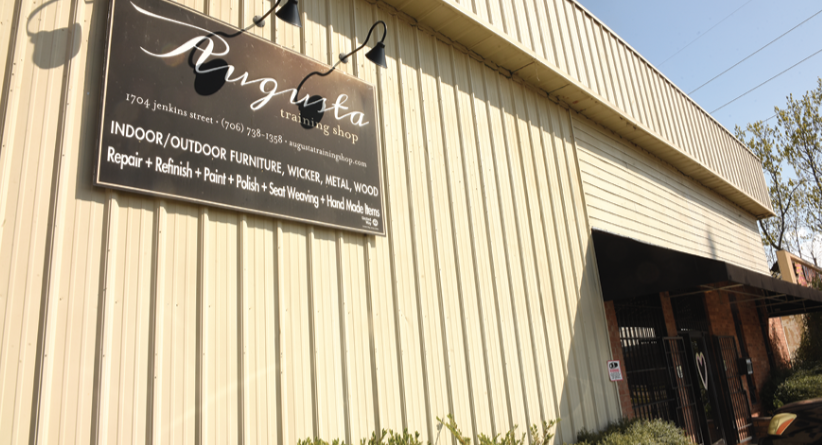
Tucked on the corner of Jenkins and Tuttle streets, the shop boasts the most comprehensive and proficient workshop in the Savannah River Region, offering caning and rush weaving, furniture restoration, painting and metal polishing services – lost arts in a world of disposable fast furniture.
Begun in 1947 as an initiative of the Augusta Area Cerebral Palsy Society, the shop morphed, after an organizational split in the 1960s, from a daycare for children living with cerebral palsy into the Augusta Training Shop, a workshop offering furniture restoration services conducted by a team of special artisans living with disabilities.
In 2000, the shop set upon a new course with Audrey Murell, a multi-disciplinary creative who began her involvement with the Training Shop as a college intern, taking over as executive director, expanding the shop’s offerings to include various furniture arts and a robust selection of fine art products.
“It is my mission to pull out skills the employees never even knew they had — weaving, greeting customers, answering phones. To get these folks get full recognition for their individuality and what they are able to contribute to the world,” Murell says. “We wanted to do something no one else was offering, [and] we were looking for additional revenue, to give our employees more jobs, [so] we started the silver polishing [business] with julep cups, utensils and tea services.”
Once that took off, Murell saw another opportunity in the painted furniture craze sweeping the nation in the early aughts, so she constructed a new facility for wood refinishing and a professional spray booth for large painting projects.

“We can paint anything you want — it doesn’t have to be furniture. We’ve painted and re-caned canoe seats before. We’ve [painted] bikes, shutters, kitchen cabinets, vanities, front doors, picture frames. We can bring teak furniture back to life,” Murell notes. “Anything you want painted or touched up; we won’t turn you down.”
Now, as furniture trends swing “grandmillennial”, a term coined by House Beautiful to describe those with a penchant for brown furniture, chintzes and needlepoint pillows, and TikTok trends like “Coastal Grandmother” and “Cottagecore” capture the attention of young tastemakers, the shop is once again ahead of the curve doing what they have always done — preserving their customers’ most precious pieces.
“We are seeing more interest in [the preservation of] family heirlooms,” Murell remarks, noting that most of the furniture they handle is “very sentimental.” While many clients bring in their wooden pieces for a full restoration, the shop is happy to preserve sentimental water rings, cigarette marks or crayon stripes if the client desires. “Some people don’t want all those years of memories to come off [and] they want to preserve it with the memories as-is,” Murell adds. “We respect that.”
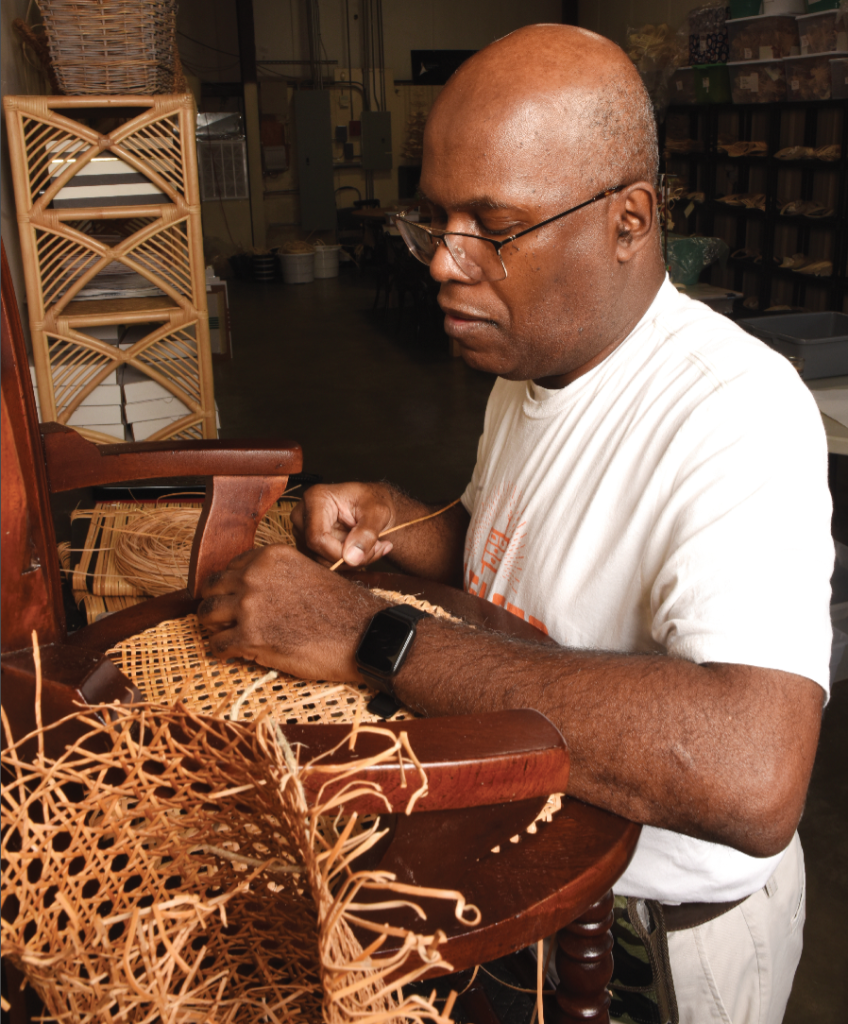
Visitors to the shop have the opportunity to meet the employees overseeing their projects along with volunteers like Tom Fuller, a retired certified public accountant, and Belle Dees, a professional cabinet painter, who assist with restoration and painting commissions, and the shop’s most tenured employee, Adrian Williams, a nonverbal creative extraordinaire, who helms the shop’s legendary caning and weaving department.
“I can take any pattern from a magazine clipping or a book, and he can weave [it]. He has woven so many of Augusta’s porch rockers and seats. I can’t explain to you enough how brilliant his mind is,” Murell says of Williams. “[Adrian] has taught other employees how to do the weaving even though he is nonverbal. He has a brilliant mind. He is an Augusta treasure.”
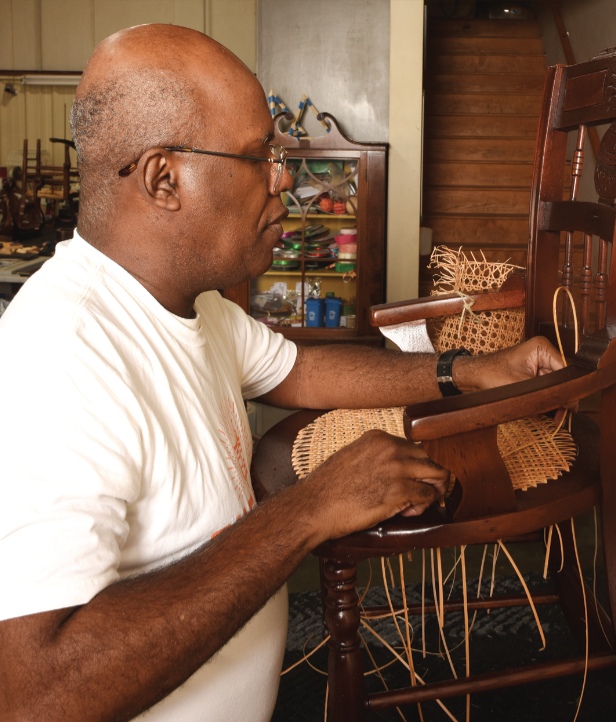
After Mr. Hicks, another employee, cleans each chair frame, removing old cane or rush, Williams deftly loops cane strips through tiny drill holes eight times, a technique known as eight-way cane, crisscrossing pieces of rattan bark in different directions to achieve the desired pattern before binding the loose strips together ensuring they stay taut against the frame.
“A typical chair could be 70 to 75 holes. It’s a very tedious process. Imagine how big a drill hole is, and you’ve got to weave in and out of that hole eight times,” Murell explains. “You have to have a lot of patience with it.”
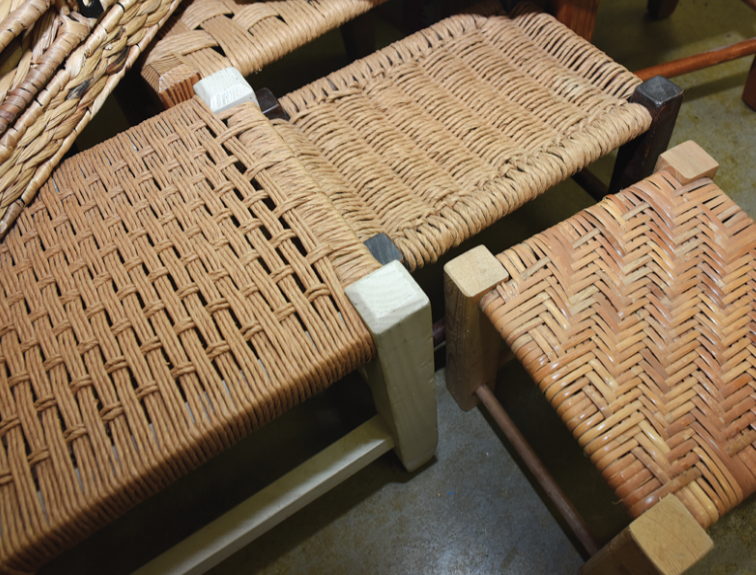
Williams’ talents extend to weaving — the shop sells custom-woven footstools featuring his woven tops and bases painted by the employees — and he works in six different mediums including seagrass, wide binder, wheat rush and bamboo caning.
The intricacy is well worth the results, Murell affirms. Historic techniques are being preserved, thousands of furniture items, accessories and dining articles have been saved from landfills, and Williams and his co-workers have been gainfully employed for decades, providing financially for their families, instilling in them a deep sense of pride, and immersing them in a celebratory community that champions their craftsmanship and humanity.
While workshop accomplishments are celebrated in-house with happy dances and clapping — Williams’ preferred congratulatory sign — the employees’ achievements are best recognized by the community at Derby Day and Bounty & Bottles, the non-profit’s signature fundraisers.
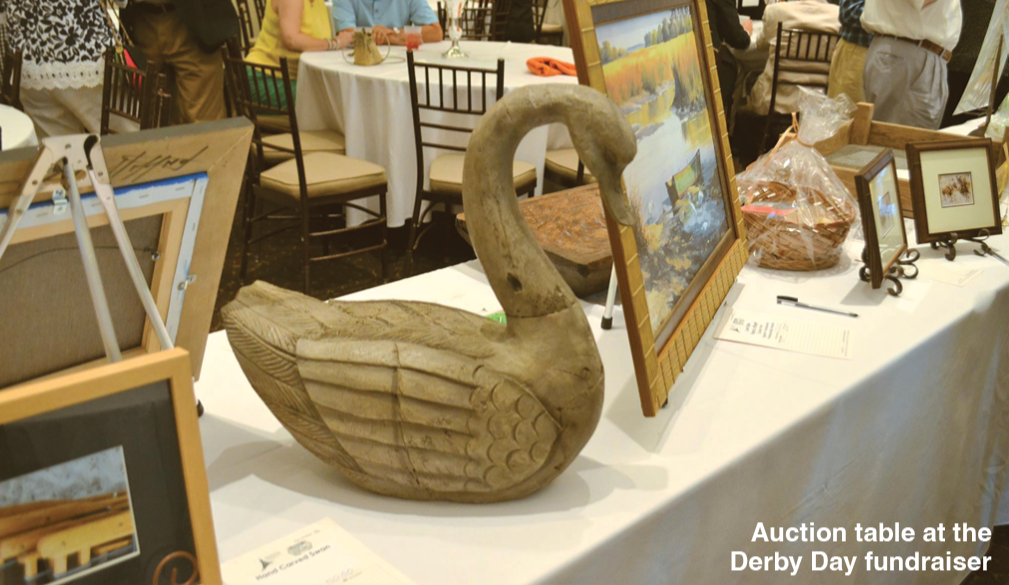
Held the first Saturday in May, the day of the Kentucky Derby, the Augusta Training Shop sets up a posh Derby viewing party with an intimate showing of artisan work, live music and games, endless barbeque and an open bar provided by 2nd City Beverage Co. and Durty Gurl commanding attention until the Thoroughbreds take to the track on the big screen.
“I love the tradition of [Derby Day]. Once people go, they usually come back year after year. It’s such a fun event at a beautiful time of year and [there is] not a better cause in Augusta!” board of directors president Rebecca (Becky) Beul notes.
With the furniture restoration and caning business thriving, fundraisers, a new summer craft camp, a retail shop renovation and fresh product offerings on the horizon, Murell and the employees have their eyes firmly set on the future, with joy and gratitude for their successes guiding the way.
“It has been truly amazing, and we thank the Augusta community for keeping us in business. We really want to expand our reach to showcase what the employees are able to do,” Murell says.
Seen in the May 2024 issue of Augusta magazine.