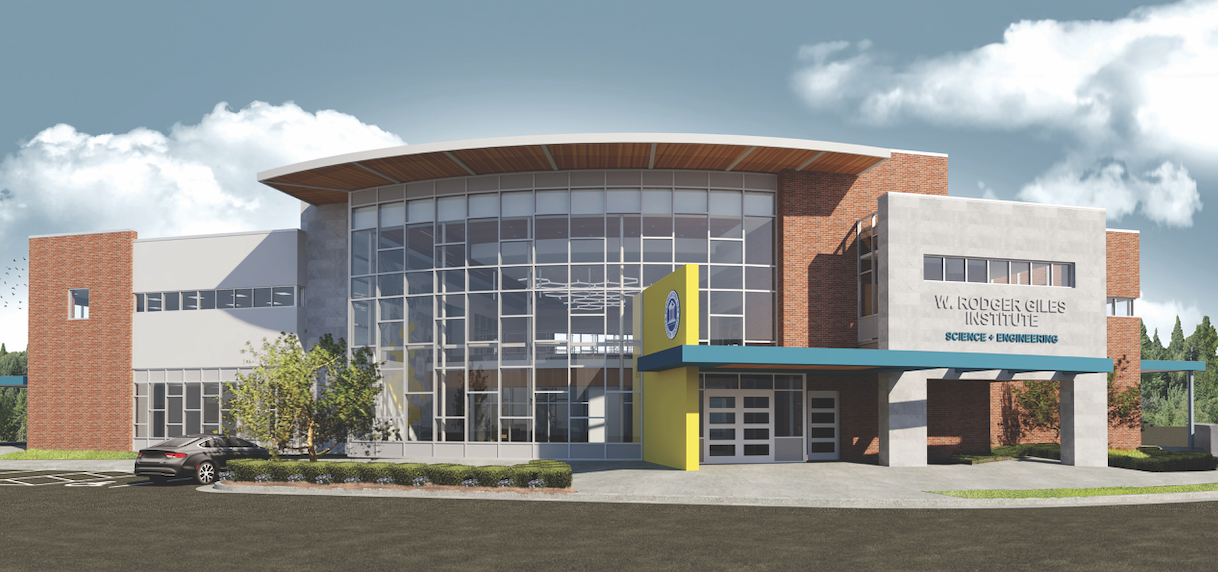
Because of an old notion, some good fortune and a lot of hard work, Augusta Preparatory Day School is leading the way in preparing students for the future with its new W. Rodger Giles Institute for Inquiry – the first of its kind in the area.
The $11.2 million facility, which welcomed students in January, is dedicated to science and technology education and includes capabilities for robotics, 3D printing, virtual and augmented reality, artificial intelligence and more.
“When I arrived five years ago, there was already a plan from 2013 that identified a need for modern science facilities on campus,” says Derrick Willard, Augusta Prep’s Head of School. In 2019, Willard and his administration wrote a new strategic plan that would fulfill the ongoing need.
“We were blessed to have a benefactor who fell in love with the idea. He said, ‘If you have a vision for this innovative capital project, I may have some funding,’” Willard recalls.
William Rodger Giles was a local entrepreneur and businessman who passed away in 2018. The benefactor said that Giles wanted his estate to impact children. “So, it was an old notion and some good fortune. Then we went to work,” Willard says.
Augusta Prep hired an architect who worked with the middle and high school students, the science and technology teachers and the school’s leadership team to devise a design concept and a set of renderings.
The school then had to sell it to investors — the idea was “wildly popular.” Between the Giles’ estate and a capital fundraising campaign, the school successfully raised the $11.2 million needed for the project.


“What’s emerged over the last three or four decades now is the technological sciences of coding, computer science, robotics and engineering.”
Derrick Willard, Head of School,
Augusta Preparatory Day School
“It’s a beautiful new building, but what’s most important is not the shiny glass and new brick. It’s the [academic] programming that goes on inside,” admits Willard.
He explained that when he arrived, the school had some world-class science and technology teaching in spaces that were built in the 1960s and 70s — very traditional, small rooms and labs.
The new state-of-the-art two-story facility is a comprehensive sciences center serving elementary, middle and high school students. “We wanted to give [students and teachers] modern, flexible, nimble spaces in which to deliver programming that, in many cases, did not exist in the 1960s and 70s.”
The facility is also comprehensive in its instructional use. “In the past, we might have thought of science as biology, chemistry and physics. What’s emerged over the last three or four decades now is the technological sciences of coding, computer science, robotics and engineering,” Willard explains.
The goal when planning and constructing the structure was to not only benefit today’s students but also the class of 2040. The vision is to arm students with the knowledge and skills to be successful in the Fourth Industrial Revolution, which is being driven by high-speed Internet, cloud technology, artificial intelligence, automation, 3D printing and big data analytics, along with the workplaces of the future. “We’re excited because we will be the only school in this area — maybe in the state — that is thinking of sciences in the broadest sense,” Willard says convincingly.


“We’re excited because we will be the only school in this area — maybe in the state — that is thinking of sciences in the broadest sense.”
Derrick Willard, Head of School,
Augusta Preparatory Day School
The first floor features a dedicated Lower School STEM lab for elementary students as well as robotics, engineering and 3D printing labs. Also located on the first floor is a virtual reality lab with a projection system and headsets. “Any discipline can book that room,” Willard notes. “A history class could have class in the Roman Coliseum, for example.”
The second floor contains modern biology, chemistry and physics labs and throughout the facility there are seating areas with dry erase walls, encouraging brainstorming and collaboration.
“In the broadest sense, we are a nonprofit school, and we exist to impact children for the better. The more children we can have join us, the more kids we can help to thrive and become successful … to lead thriving communities in the future,” Willard says. “It doesn’t mean we’ve suddenly specialized. We still value the arts, humanities and athletics. I don’t think any educator can ignore the impact of these technologies on our children’s future.”
During the summer, the facility will be open to the community through the school’s popular summer camps. “We truly want this to be a community asset,” states Willard. “For me as a leader, it’s important we change the conversation about science education in this market. All boats rise on the same tide, so if all the schools are thinking about making children successful in the Fourth Industrial Revolution, every school will start to have facilities like this …. This really is the Swiss Army knife of science buildings.”

Photos by Mark Albertin
Seen in the February/March 2024 issue of Augusta magazine.